Published on : 19 Apr 2026
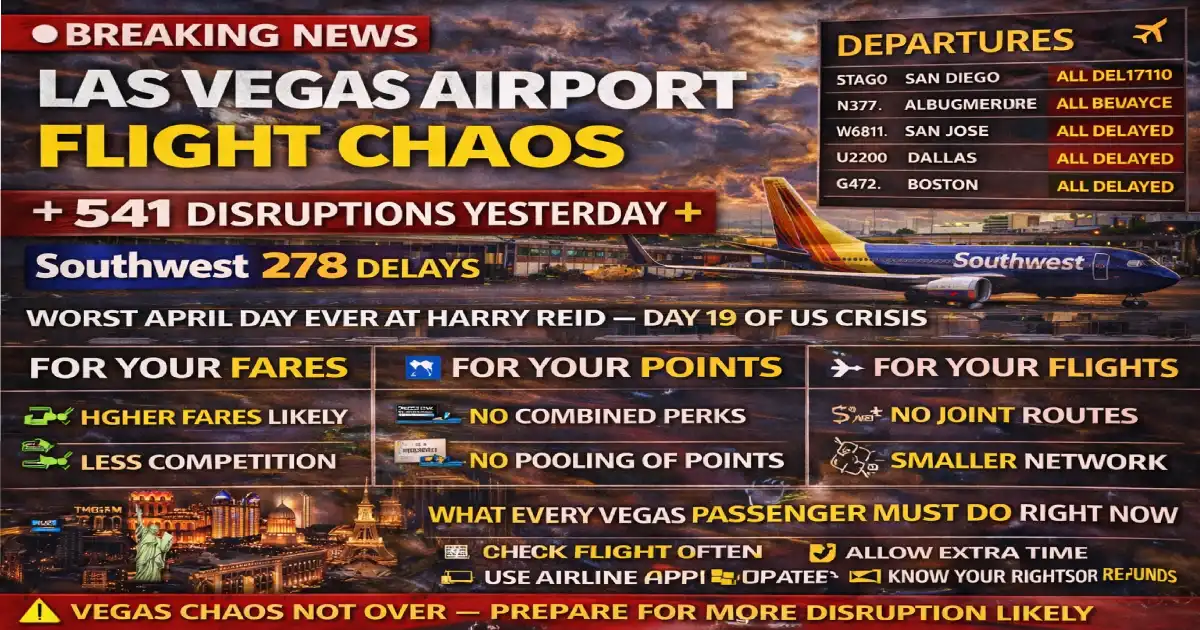
Saturday April 18 was the worst single day in April 2026 for Harry Reid International Airport — and Sunday is the critical recovery test.
Harry Reid International Airport in Las Vegas recorded 490 delays and 51 cancellations — 541 total disruptions — its worst day of April 2026, reflecting the catastrophic cascade of a Southwest Airlines network absorbing the national weather shock. Travel Tourister
That 541-disruption total made Las Vegas the second worst airport in the entire United States on Saturday, ranking behind only Chicago O’Hare’s 718-disruption flood-driven meltdown. Southwest Airlines led the chaos with 278 delays and 3 cancellations — the single carrier accounting for more than half of all Las Vegas disruptions on the day. If you flew through Harry Reid on Saturday and are still trying to get home — or if you are flying out of Las Vegas today — this is everything you need to know.
Published: April 19, 2026 — Sunday Yesterday’s total (April 18): 541 disruptions — 490 delays + 51 cancellations Rank: Second worst airport in the US on April 18 (behind O’Hare 718) Worst carrier: Southwest Airlines — 278 delays + 3 cancellations Also disrupted: Frontier 31 delays + 5 cancels · United 40 delays · American 36 delays · Delta 36 delays · Alaska Airlines also hit Routes broken: Las Vegas → Los Angeles, Denver, Chicago, Phoenix, New York, San Francisco, Dallas, Seattle, Orlando Root cause: Southwest’s point-to-point network absorbing 18 days of accumulated national weather strain — O’Hare flood cascade + Midwest storm backlog Today (Sunday April 19): Recovery underway but winds 20–30mph gusting to 45mph at LAS — partial weather risk Recovery timeline: Airlines targeting Sunday–Monday for meaningful network reset Southwest no-interline rule: ⚠️ If Southwest cancels your flight, you CANNOT be rebooked onto United, Delta, American or any other carrier DOT rights: No fixed cash compensation for weather delays, but controllable delay rights apply — see full guide below
Las Vegas does not experience 541 disruptions because of local weather. Saturday’s skies above the Nevada desert were largely clear. The crisis at Harry Reid was imported — the product of a national aviation system that has been running without a clean recovery day for 18 straight days, and a Southwest Airlines network whose structural architecture means every major disruption anywhere in America eventually becomes a Las Vegas problem.
Saturday April 18, 2026 is the second-worst day of the 18-day post-Easter US aviation crisis — 4,651 total disruptions nationally. Las Vegas Harry Reid records 541 disruptions — its worst April day — as Southwest Airlines posts a crisis-record 1,030 national delays. Travel Tourister
To understand why Las Vegas absorbed so much of Saturday’s national chaos, you need to understand how Southwest Airlines works.
Aviation analysts note that Southwest’s point-to-point network, combined with older crew-scheduling tools, makes it more difficult for Southwest to recover quickly when large portions of its map are disrupted. A dense web of short-haul flights, reliance on quick aircraft turnarounds and complex crew rotations across multiple cities can amplify the effect of weather-related interruptions far from a given flight’s origin.
Las Vegas is one of Southwest’s most important bases. Southwest holds 35%+ of Harry Reid traffic by market share — the #1 airline at the airport by passengers carried. Travel Tourister Southwest operates Las Vegas as a hub in practice — dozens of daily departures to Los Angeles, Denver, Phoenix, Dallas Love Field, Chicago Midway, Orlando, Seattle and dozens of other cities. When the Chicago O’Hare flooding on April 14–15 knocked hundreds of Southwest aircraft and crews out of position across the Midwest, those delays cascaded westward through the network. Aircraft that were supposed to arrive from Chicago, Minneapolis and Denver arrived late to Las Vegas. Crews that had timed out in the Midwest could not fly their scheduled Las Vegas sectors. And the Las Vegas departures — fully loaded with passengers who had gambled, watched shows, and attended conventions — sat at the gate waiting for aircraft that weren’t there.
Southwest Airlines recorded the highest number of delays, with 278 flights affected along with 3 cancellations. Frontier Airlines reported 31 delays and 5 cancellations — the highest cancellation figure among all airlines at the airport on the day.
If there is one piece of information that every delayed Southwest passenger at Las Vegas needs to understand, it is this.
Southwest does not operate a hub-and-spoke system. Southwest does not interline passengers onto other carriers. If Southwest cancels your flight, Southwest will rebook you onto the next available Southwest flight — which on a peak disruption day may be 24–48 hours away. Travel Tourister
This is the single most consequential operational difference between Southwest and every other major US airline. When Delta cancels a flight, Delta will rebook you onto United, American, or Alaska. When United cancels a flight, United will rebook you onto competing carriers. When Southwest cancels a flight, Southwest can only put you on another Southwest flight.
On a day when Southwest has already posted 278 delays at Las Vegas alone — and its next day’s schedule is still recovering from 18 days of accumulated national strain — the “next available Southwest flight” to your destination may not be today. It may be tomorrow. It may be Monday.
What this means practically:
Flight operations at Harry Reid International Airport were heavily impacted, with 531 delays and 10 cancellations recorded. Airlines affected included Southwest Airlines, United Airlines, American Airlines, Delta Air Lines, Frontier Airlines, and Alaska Airlines across routes spanning Las Vegas, Los Angeles, Denver, Phoenix, and Chicago.
Southwest Airlines: 278 delays + 3 cancellations Dominant carrier at Harry Reid, dominant source of disruption. Routes to Los Angeles, Denver, Phoenix, Chicago Midway, Dallas Love Field, Seattle, Orlando and Baltimore all affected. Southwest’s entire Las Vegas operation runs on the same tight-turn model — when inbounds are late, every subsequent sector is late.
Frontier Airlines: 31 delays + 5 cancellations Frontier Airlines reported the highest cancellations figure among all airlines at the airport with 5 flights cancelled. Frontier operates primarily leisure routes from Las Vegas — Los Angeles, Denver, Phoenix, Orlando, Atlanta. Its 5 cancellations represent a disproportionately high percentage of its smaller Las Vegas operation.
United Airlines: 40 delays United operates Las Vegas as a secondary leisure market, with connections to its San Francisco, Los Angeles and Denver hubs. United passengers connecting to international flights at SFO or LAX faced the highest risk — a 90-minute delay leaving Las Vegas can eliminate a transatlantic connection buffer entirely.
American Airlines: 36 delays American connects Las Vegas to Phoenix, Dallas/Fort Worth, Chicago O’Hare, New York JFK, Charlotte and Miami. American passengers whose connections routed through O’Hare on Saturday faced the worst double disruption — delays at Las Vegas feeding into an already-flooded Chicago hub.
Delta Air Lines: 36 delays Delta connects Las Vegas to Salt Lake City, Seattle, Minneapolis, Atlanta and New York. Delta’s presence at Harry Reid is smaller than at many Western US airports, but Saturday’s disruptions reflect the national system strain hitting every carrier simultaneously.
Alaska Airlines: Disrupted Alaska connects Las Vegas to Seattle, Portland, San Francisco and Los Angeles. Alaska passengers should check for any ongoing Alaska-issued travel waivers at alaskaair.com.
The disruption at Las Vegas on Saturday was most acute on routes connecting to other already-disrupted hubs:
Las Vegas → Los Angeles (LAX): LAX was itself recording 260 disruptions on Saturday — the fourth worst airport in the country. A Las Vegas delay feeding into LAX’s own backlog multiplied the misconnection risk for any passenger making an onward connection at LAX.
Las Vegas → Chicago (O’Hare and Midway): O’Hare recorded 718 total disruptions on Saturday — the worst airport in the US. Chicago Midway (Southwest’s Chicago hub) also recorded significant cancellations. Any Las Vegas–Chicago itinerary on Saturday was extremely high risk.
Las Vegas → Denver: Denver was a major system pressure point throughout April. Las Vegas–Denver connections via Southwest are among the busiest leisure routes in the country — and were among the most disrupted.
Las Vegas → New York (JFK, LaGuardia, Newark): The Northeast is the furthest point from Las Vegas in the continental US — the longest recovery window. Passengers who missed New York connections on Saturday faced the highest probability of overnight stays.
Las Vegas → Phoenix: Phoenix was recording its own elevated disruption. Las Vegas–Phoenix is a short Southwest sector — but on a day with 278 Southwest delays at Harry Reid, even short sectors were hours behind schedule.
Airlines are targeting Sunday April 19 for the beginning of meaningful recovery — contingent on no new major weather events entering the Chicago corridor or Las Vegas airspace. The critical variable is whether Southwest can begin the 48-72 hour process of repositioning its 1,000+ delayed aircraft and crews back to scheduled base positions. If Sunday’s weather cooperates, Monday April 20 could show the first sub-2,000 disruption day since Easter week. Travel Tourister
The Las Vegas weather picture for Sunday April 19 is partially cooperative but not clean. Winds are forecast at 20–30mph with gusts to 45mph, with a 20% chance of afternoon rain showers. Gusts to 45mph at a desert airport do not cause cancellations, but they slow runway operations, increase approach spacing requirements, and push turnaround times out. This is not a clean recovery day — it is a partial recovery day.
What to expect Sunday:
American passenger rights at Las Vegas differ significantly from EU261 protections that UK and European travellers are used to. Here is the precise picture:
If your flight is CANCELLED:
✅ Full cash refund to your original payment method — this right applies for any cancelled flight regardless of the cause. Airlines cannot force you to accept a travel voucher instead. This is unconditional under DOT regulations.
✅ Rebooking on the next available flight at no additional cost — the airline must offer this. For Southwest, that means next available Southwest. For United, Delta and American, that can include rebooking onto partner airlines.
✅ Hotel and meals for controllable cancellations — if the cancellation is due to factors within the airline’s control (mechanical fault, crew shortage, scheduling failure — NOT weather), major airlines have voluntarily committed under DOT agreements to provide meals for delays of 3+ hours and hotels for overnight stays. Southwest, United, American, Delta and Alaska have all made these commitments.
If your flight is DELAYED:
✅ Meals for delays of 3+ hours (controllable) — same DOT commitment applies. For weather delays, airlines are not required to provide meals but most still offer vouchers. Ask at the gate immediately — do not wait.
✅ Tarmac delay protection — if you are on board an aircraft and it has been on the tarmac for more than 3 hours on a domestic flight (4 hours for international), the airline must offer passengers the opportunity to disembark. Violation carries federal fines of up to $27,500 per passenger.
What US law does NOT guarantee:
❌ Fixed cash compensation for delays — there is no US equivalent of EU261’s €250–€600. If your flight is delayed 4 hours due to weather, you receive no automatic cash payment.
❌ Involuntary rebooking onto a competitor’s aircraft (for Southwest) — Southwest does not interline. Only Southwest bookings are possible.
❌ Compensation for consequential losses — missed hotel nights, non-refundable show tickets, car hire bookings, missed cruises. These are travel insurance claims, not airline obligations.
If you are at Harry Reid today (Sunday):
✅ Step 1: Check your flight status before leaving your hotel. Do not assume the departure time you checked last night is still accurate. Use your airline’s app — not Google Flights or the airport website, which update more slowly. If your flight shows more than 30 minutes of delay already, that delay will almost certainly grow through the day.
✅ Step 2: Arrive early. The normal recommendation is 2 hours for domestic. Today at Harry Reid: 2.5 hours minimum. Security checkpoint wait times have been elevated all week due to nationwide system strain. Check live TSA wait times at the Harry Reid website (mccarran.com) before leaving.
✅ Step 3: Track your inbound aircraft tail number using FlightAware (flightaware.com). Search for your flight number and look at where the inbound aircraft is coming from. If it is currently delayed in Chicago, Denver or Los Angeles, your departure is almost certainly going to be late even if the board says “On Time.”
✅ Step 4: Enable push notifications on your airline app. Changes happen rapidly on high-disruption days. The app notification will arrive faster than the departure board update.
✅ Step 5: If your flight is cancelled — act immediately. Do NOT queue at the gate desk. Use the airline app for rebooking. If the app is not working, call the airline’s disruption line. Every minute you wait, alternative seats fill.
✅ Step 6: If delayed 3+ hours (controllable delay) — ask for meal vouchers. Go to the gate agent and say: “My flight has been delayed over three hours. I would like meal vouchers.” Keep all food receipts regardless of whether vouchers are provided.
✅ Step 7: Know the Southwest no-interline rule. If you are on Southwest and your flight is cancelled, do not assume you will be automatically rebooked onto United or Delta. You will be rebooked onto the next available Southwest service — which may be tomorrow.
| Airline | How to rebook first | Phone | App |
|---|---|---|---|
| Southwest | southwest.com → Change/Cancel | 1-800-435-9792 | Southwest App |
| Frontier | flyfrontier.com → My Trips | 1-801-401-9000 | Frontier App |
| United | united.com → My Trips | 1-800-864-8331 | United App |
| American | aa.com → My Trips | 1-800-433-7300 | American App |
| Delta | delta.com → My Trips | 1-800-221-1212 | Fly Delta App |
| Alaska | alaskaair.com → My Trips | 1-800-252-7522 | Alaska App |
Harry Reid International Airport:
File a DOT consumer complaint:
Las Vegas has appeared in the US disruption story repeatedly throughout April 2026. Harry Reid recently reported that it closed 2025 with nearly 55 million passengers, making it one of the busiest airports in the country. That growth trajectory is continuing into 2026, leaving airport infrastructure and airline schedules operating close to capacity during peak periods.
A combination of factors created the perfect storm: saturated national airspace, upstream weather delays in the Midwest and East Coast, and air traffic control constraints at connecting hubs. Even though local conditions around Las Vegas remained relatively stable, network-level congestion elsewhere cascaded westward, trapping Vegas-bound flights in holding patterns.
Las Vegas is uniquely vulnerable because almost all of its aviation demand is discretionary leisure travel. Passengers flying into Las Vegas for a weekend cannot travel on another day — the hotel is booked, the show tickets are purchased, the conference is fixed. When they miss their inbound or outbound flight, the economic consequences are immediate: missed shows, forfeited non-refundable hotel nights, unused concert tickets. The financial stakes for a delayed Las Vegas passenger are often higher than for a business traveller who simply misses a meeting and reschedules.
Southwest Airlines, United, American, Delta, and Alaska Airlines have all issued travel waivers allowing passengers to rebook on alternative flights without fees. The cascading nature of these delays means a traveler delayed in Las Vegas may experience compounding effects at their final destination. A two-hour ground delay in Vegas can transform into a missed connection in Denver, Chicago, or New York, triggering additional rebooking hassles and potentially stranding luggage for hours or days.
Posted By : Vinay
Lastest News
2nd Floor, 39, Above Kirti Club, DLF Industrial Area, Kirti Nagar, New Delhi, Delhi 110015



Travel Tourister is a leading Travel portal where we introduce travellers to trusted travel agents to make their journey hasselfree, memorable And happy. Travel Tourister is a platform where travellers get Tour packages ,Hotel packages deals through trusted travel companies And hoteliers who are working with us across the world. We always try to find new and more travel agents and hoteliers from every nook and corners across the world so that you could compare the deals with different travel agents and hoteliers and book your tour or hotel with the one you have chosen according to your taste and budget.
Copyright © Travel Tourister, India. All Rights Reserved

 Call
Call Enquiry